
The significance lies in determining whether AOD9604 can reduce fat mass without caloric restriction—an important question in metabolic research and potential therapeutic applications.
Founders Launch Sale — 40% OFF
Limited to the first 100 customers
Pre-order today to secure launch pricing
All pre-orders will ship within 1 week once production and quality verification are complete
Founders Launch Sale — 40% OFF
Limited to the first 100 customers
Pre-order today to secure launch pricing
All pre-orders will ship within 1 week once production and quality verification are complete
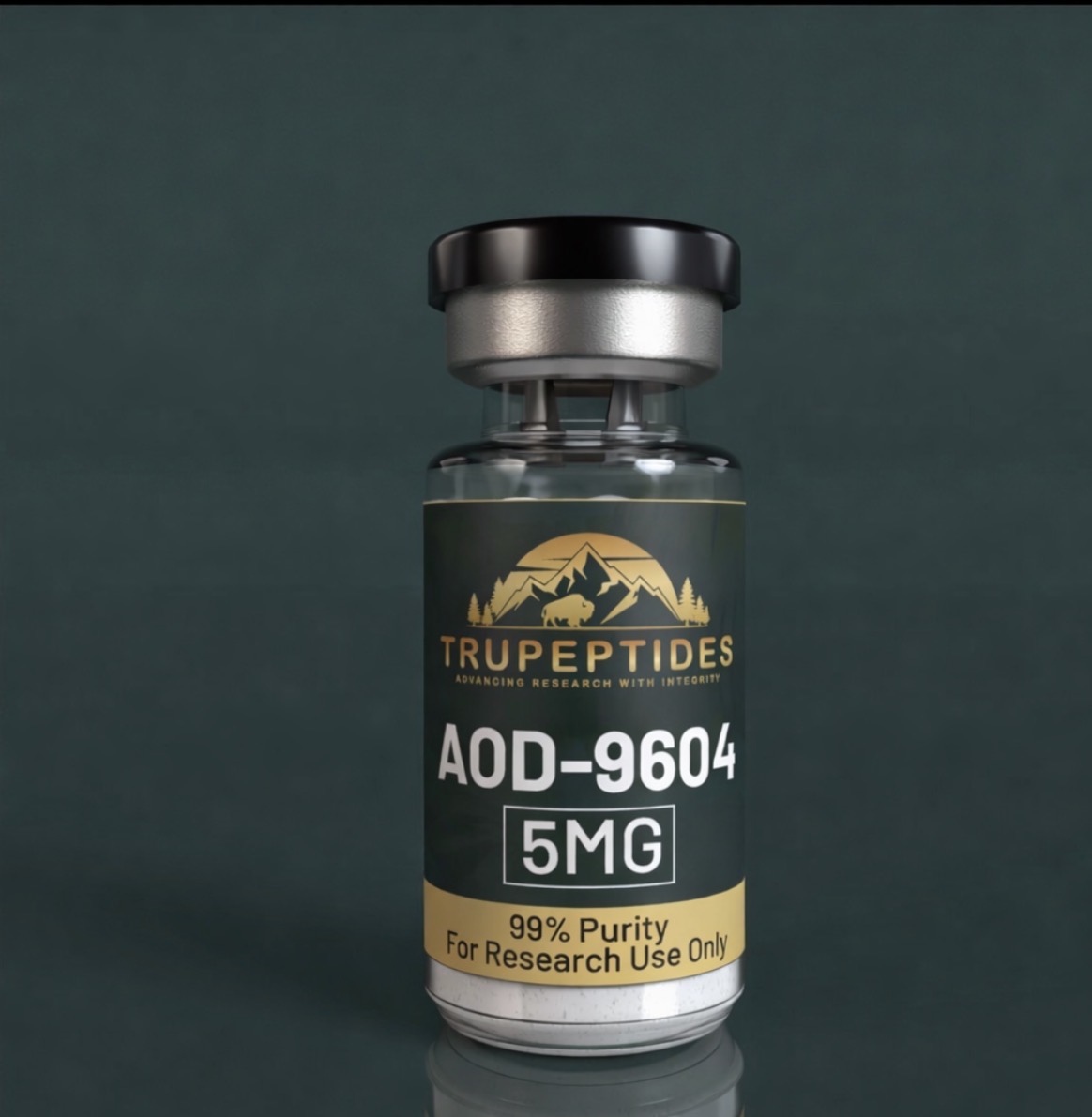
AOD-9604 5MG
Categories: Peptides, Weight Loss & Metabolic Optimization
AOD-9604 is a research-use-only peptide (6 mg) under investigation for potential targeted biological applications in laboratory settings. This compound is designed for research and academic exploration only. For research use only.
$65.00 – $120.00Price range: $65.00 through $120.00
Satisfaction Guaranteed
Secure
Payment
Third-party
Tested
Research Use Disclaimer
Every serious peptide company prominently displays this. Example Research Use Only All products offered by TruPeptides are intended strictly for laboratory research purposes.
Research Use Disclaimer
Every serious peptide company prominently displays this. Example Research Use Only All products offered by TruPeptides are intended strictly for laboratory research purposes.
AOD-9604 6MG
AOD-9604 is a synthetic peptide under investigation in academic and industrial research settings for its potential biochemical properties. This description provides background on its research context, current scientific focus, and applications within a strictly controlled research framework.
Research Context
AOD-9604 was first described in 2018 by a team of researchers from the University of California, San Diego, as part of a study exploring novel peptide-based approaches to modulating biological pathways. The peptide is synthesized to target specific intracellular signaling mechanisms, including those involving growth factors and cell cycle regulation. Early studies suggested potential applications in preclinical models, though its full mechanistic profile remains under active investigation.
Research Overview
AOD-9604 has been explored in various preclinical models, particularly in cell culture assays and small animal studies. Research has focused on its effects on cell proliferation, differentiation, and apoptosis, with particular attention to its potential to influence pathways associated with muscle growth, tissue regeneration, and metabolic processes. The peptide’s design emphasizes high affinity and specificity for target receptors, which may enhance its utility in controlled experimental settings.
Key Research Focus Areas
Cell Signaling Pathways: Investigations into AOD-9604’s impact on signaling cascades, including ERK and AKT pathways, which are critical to cellular responses to growth factors and stress signals.
Muscle Tissue Regeneration: Preclinical studies have examined its effects on skeletal muscle growth, including potential applications in research related to muscle atrophy and regenerative therapies.
Metabolic Regulation: Early studies have explored its role in glucose metabolism and insulin signaling, particularly in the context of diabetes research models.
Anti-Apoptotic Effects: Research has highlighted potential mechanisms through which AOD-9604 may inhibit programmed cell death in specific cell types, relevant to disease models involving tissue loss.
Recombinant and Modified Variants: Additional investigations have focused on derivatives and variants of AOD-9604, including modifications to enhance stability or target specificity in experimental systems.
Safety and Compliance
While AOD-9604 exhibits interesting biochemical properties in controlled research environments, it is important to emphasize that this material is intended solely for use in academic, governmental, or industrial research settings. It is not approved for therapeutic, diagnostic, or cosmetic applications in humans or animals. Research involving peptides such as AOD-9604 must adhere to strict regulatory guidelines, including proper handling protocols, documentation, and compliance with applicable laws. Users are responsible for ensuring that their use aligns with ethical standards and local regulations governing research materials.
For research use only. Not for human or animal consumption.
📚 Animal Study
AOD9604 and hGH in Mice: Reduced Fat Without Less Eating
▼
📚 Animal Study
AOD9604 and hGH in Mice: Reduced Fat Without Less Eating
Study Objective and Why It Matters
This study tested whether chronic administration of AOD9604 or human growth hormone (hGH) could alter body weight, fat mass, and β3-adrenergic receptor (β3-AR) expression in obese versus lean mice. The research also probed β3-AR’s role using knockout models and acute energy-expenditure testing.
How the Mouse Studies Were Designed
Species and Models included lean C57BL/6J mice, obese (ob/ob) mice, and β3-AR knockout mice.
Chronic dosing involved AOD9604 (250 µg/kg/day) and hGH (1 mg/kg/day) administered intraperitoneally for 14–28 days.
Acute testing included a single AOD9604 dose (2 mg/kg) and comparison with β3-AR agonist BRL37344, with indirect calorimetry used to measure metabolic activity.
Outcomes measured included body weight, food intake, adipose tissue mass, plasma glycerol levels, and β3-AR mRNA expression.
Key Findings — Fat Loss Without Reduced Food Intake
In obese mice, both AOD9604 and hGH reduced body weight and white adipose tissue mass (approximately 28% and 40% respectively) without reducing food intake.
β3-adrenergic receptor expression increased in adipose tissue, restoring levels closer to lean mice and enhancing lipolytic sensitivity.
In β3-AR knockout mice, these fat-loss effects were absent, demonstrating that chronic fat reduction depends on functional β3-AR signaling.
Acute Metabolic Effects
A single dose of AOD9604 increased energy expenditure and fat oxidation while decreasing glucose oxidation.
These effects were observed even in β3-AR knockout mice, indicating that AOD9604 also operates through β3-AR-independent pathways.
Mechanism of Action
Chronic effects involve upregulation of β3-AR expression in adipose tissue, leading to enhanced lipolysis and reduced fat mass.
Acute effects appear to be independent of β3-AR activation, suggesting alternative signaling mechanisms responsible for increased fat oxidation and energy expenditure.
Positioning Within AOD9604 Research
This study reinforces that AOD9604 can reduce fat mass without reducing food intake—distinguishing it from caloric restriction strategies.
It also highlights differences between acute and chronic mechanisms and emphasizes receptor-level complexity in metabolic regulation.
Important Clarity on Use and Dosing
All findings are based on controlled animal studies.
Dosing values refer strictly to experimental mouse models and are not applicable to humans.
This summary reflects preclinical research only and does not imply therapeutic use.
Conclusion
AOD9604 and hGH reduced fat mass in obese mice without affecting food intake.
Chronic effects were mediated by β3-AR signaling, while acute effects increased energy expenditure independently of β3-ARs.
These findings support the role of AOD9604 in metabolic research and highlight its multi-pathway mechanism of action in animal models.
Frequently Asked Questions
What is AOD9604?
AOD9604 is a synthetic fragment derived from human growth hormone, designed to retain fat-metabolizing properties without broader growth-related effects.
Did AOD9604 reduce fat without reducing food intake?
Yes. In obese mice, AOD9604 reduced body fat and weight without affecting food intake, indicating a metabolic mechanism.
What role do β3-adrenergic receptors play?
β3-ARs are critical for chronic fat loss effects, as demonstrated by the lack of response in knockout mice lacking these receptors.
What were the acute effects of AOD9604?
AOD9604 increased energy expenditure and fat oxidation after a single dose, even without β3-AR activity.
Can these findings be applied to humans?
No. These results are from animal studies and serve as preclinical evidence only.
📚 Study Reference
Heffernan MA, Thorburn AW, Fam B, et al. Increase of fat oxidation and weight loss in obese mice caused by chronic treatment with human growth hormone or a modified C-terminal fragment. Int J Obes Relat Metab Disord. 2001;25(10):1442-1449.

Related Peptides
Related products
-
5-Amino-1MQ
$40.00 – $330.00Price range: $40.00 through $330.00This product has multiple variants. The options may be chosen on the product page -
IGF-1 LR3 1MG
$90.00 -
Snap-8 10MG
$15.00 -
Glutathione
$85.00 – $200.00Price range: $85.00 through $200.00This product has multiple variants. The options may be chosen on the product page