
It was initially proposed as a sleep-regulating factor, particularly associated with delta-wave (deep) sleep, although its exact biological role remains incompletely understood.
Founders Launch Sale — 40% OFF
Limited to the first 100 customers
Pre-order today to secure launch pricing
All pre-orders will ship within 1 week once production and quality verification are complete
Founders Launch Sale — 40% OFF
Limited to the first 100 customers
Pre-order today to secure launch pricing
All pre-orders will ship within 1 week once production and quality verification are complete
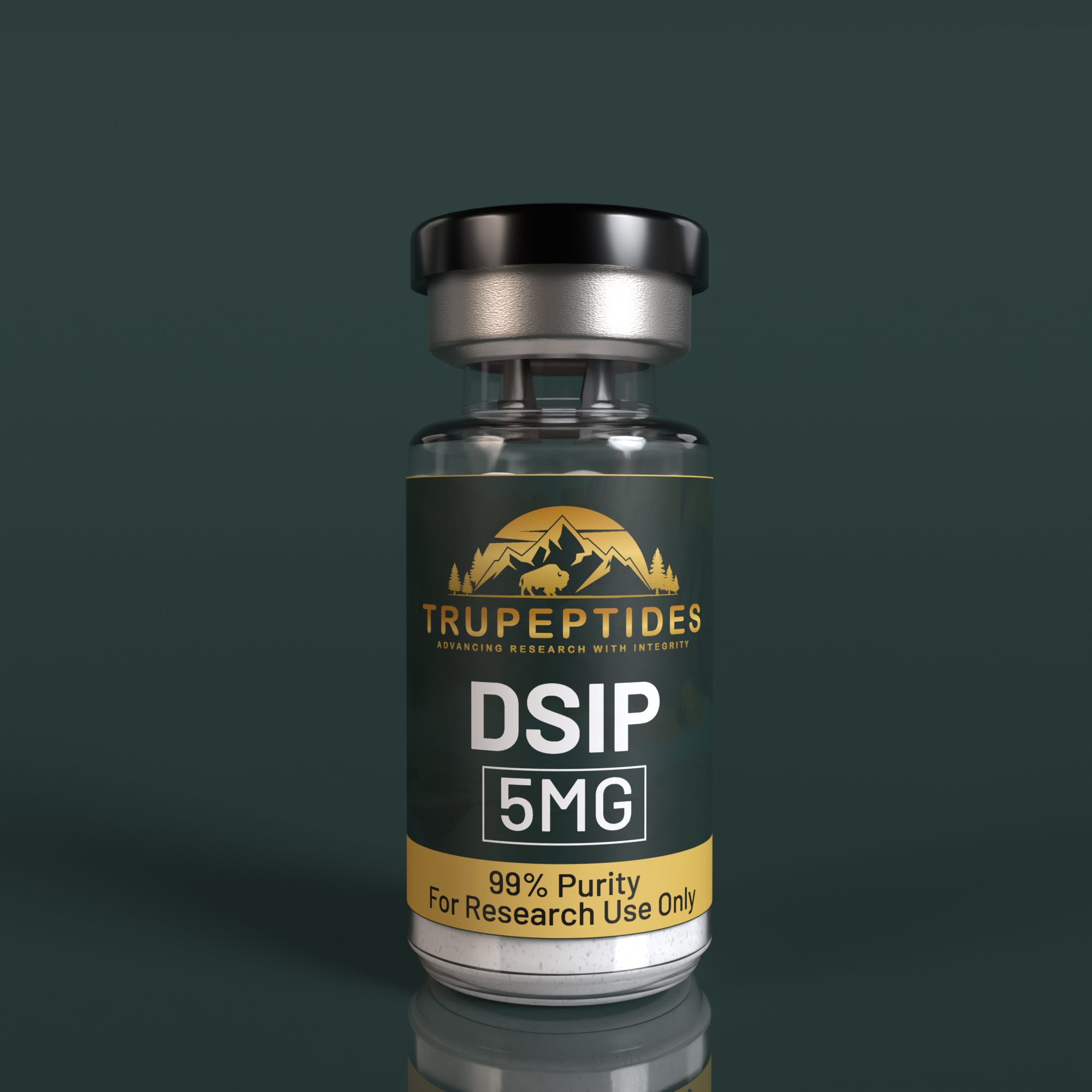
DSIP
Categories: Cognitive & Neurological Support, Peptides
DSIP (Decapeptide Sleep-Inducing Polypeptide) is a synthetic peptide used for research applications in laboratory contexts. This compound, derived from bovine serum, has been studied for its potential effects on sleep regulation. For research use only.
$45.00 – $120.00Price range: $45.00 through $120.00
Satisfaction Guaranteed
Secure
Payment
Third-party
Tested
Research Use Disclaimer
Every serious peptide company prominently displays this. Example Research Use Only All products offered by TruPeptides are intended strictly for laboratory research purposes.
Research Use Disclaimer
Every serious peptide company prominently displays this. Example Research Use Only All products offered by TruPeptides are intended strictly for laboratory research purposes.
DSIP (Decapeptide)
Decapeptide Ser-Gly-Asn-Ile-Pro-Gly-Lys-Pro-Pro (DSIP) is a synthetic peptide derived from the decapeptide sequence originally identified in mammalian brain tissue. This peptide is utilized in academic and industrial research settings for studying physiological processes, neurobiological mechanisms, and pharmacological interactions in non-human models.
Research Context
DSIP was first isolated from bovine brain extracts in the 1970s and has since been recognized for its regulatory role in sleep and circadian rhythms, as well as its involvement in modulating immune responses and endocrine function. In research contexts, DSIP is often employed to investigate the molecular pathways through which neuropeptides influence neuronal activity, synaptic transmission, and stress responses. Its structural and functional properties make it a valuable tool for probing fundamental biological mechanisms.
Research Overview
DSIP has been extensively studied in non-human models, including rodents, primates, and other laboratory animals, to explore its effects on sleep architecture, circadian behavior, and stress-induced physiological changes. Its potential applications in research include studying neuroendocrine regulation, immune modulation, and the development of peptide-based pharmacological agents for therapeutic purposes in future preclinical investigations. The peptide’s ability to cross biological membranes makes it a useful probe for examining intracellular signaling pathways and receptor interactions.
Key Research Focus Areas
- Sleep Regulation: DSIP has been associated with promoting deep sleep phases and modulating REM sleep. Research has examined its role in sleep architecture and its potential to elucidate mechanisms underlying insomnia and sleep disorders.
- Circadian Rhythm Control: Studies have explored DSIP’s impact on circadian oscillations, particularly in relation to hormonal and behavioral rhythms in non-human models.
- Immune System Modulation: Preclinical research has investigated DSIP’s effects on immune cell activity, cytokine production, and inflammatory responses, contributing to understanding its broader physiological functions.
- Neuroendocrine Interactions: DSIP has been studied in the context of hypothalamic-pituitary-adrenal (HPA) axis regulation, particularly in relation to stress responses and stress-related behavioral phenotypes.
- Neuroprotective and Antioxidant Effects: Emerging research has examined DSIP’s potential neuroprotective properties, including its role in mitigating oxidative stress and neuronal damage in various experimental models.
Important Safety and Compliance Note
This product is intended solely for academic and industrial research purposes. DSIP must be handled with appropriate laboratory safety protocols, and all experimental procedures must adhere to established ethical guidelines and regulatory standards applicable to the institution conducting the research. Use is restricted to authorized personnel trained in handling peptides for non-human research applications. This material is not intended for human or animal consumption.
For research use only. Not for human or animal consumption.
📚 Peer-Reviewed Study
Delta Sleep-Inducing Peptide (DSIP): Neurophysiology and Unresolved Mechanisms in Sleep Regulation
▼
📚 Peer-Reviewed Study
Delta Sleep-Inducing Peptide (DSIP): Neurophysiology and Unresolved Mechanisms in Sleep Regulation
Introduction to DSIP
Delta Sleep-Inducing Peptide (DSIP) is a naturally occurring neuropeptide first isolated in 1977 from cerebral venous blood.
Research Objective
The referenced study aimed to evaluate the physiological role of DSIP and assess whether it functions as a true endogenous sleep-promoting peptide.
Researchers also examined its distribution, biological activity, and potential involvement in neuroendocrine regulation.
Study Design and Methodology
This work is a comprehensive review of biochemical, physiological, and neuroanatomical studies related to DSIP.
It evaluates evidence from animal models, immunohistochemical mapping, and experimental analog studies to determine DSIP’s biological relevance.
Key Findings — Broad Biological Activity
The study highlights that DSIP exhibits a wide range of biological activities beyond sleep, including potential roles in stress response, endocrine signaling, and neurophysiology.
However, evidence directly linking native DSIP to sleep induction remains limited and inconclusive. :contentReference[oaicite:0]{index=0}
Mechanisms of Action
DSIP-like immunoreactivity has been observed in hypothalamic nuclei, suggesting involvement in neuroendocrine regulation rather than direct sleep induction.
The study proposes that DSIP-like peptides or analogues may be responsible for observed biological effects rather than DSIP itself. :contentReference[oaicite:1]{index=1}
Implications for Sleep and Neuroendocrine Research
DSIP remains a subject of ongoing investigation due to its complex and not fully defined role in physiology.
Its broad activity profile suggests potential involvement in stress modulation, hormonal regulation, and central nervous system function.
Conclusion
While DSIP was originally proposed as a sleep-inducing factor, current evidence suggests its role is more complex and not fully established.
Further research is required to clarify its biological function and identify the mechanisms underlying DSIP-like activity.
Frequently Asked Questions (FAQ)
What is DSIP?
DSIP is a naturally occurring neuropeptide originally associated with the regulation of sleep and neuroendocrine activity.
Does DSIP directly induce sleep?
Evidence suggests that its role as a direct sleep-inducing peptide is not fully established and remains under investigation.
Where is DSIP found in the body?
DSIP-like activity has been observed in hypothalamic regions associated with neuroendocrine regulation.
What makes DSIP unique?
Its biological activity is broad and not fully understood, with no clearly identified receptor or gene.
Is DSIP well understood scientifically?
No. It is considered one of the more unresolved peptides in neurobiology research.
📚 Study Reference
Kovalzon V.M. et al. J Neurochem. 2006;97(2):303-309.

Related Peptides
Related products
-

Cerebrolysin 60MG
$400.00 -
IGF-1 LR3 1MG
$90.00 -
KPV 10MG
$100.00 -
Snap-8 10MG
$15.00